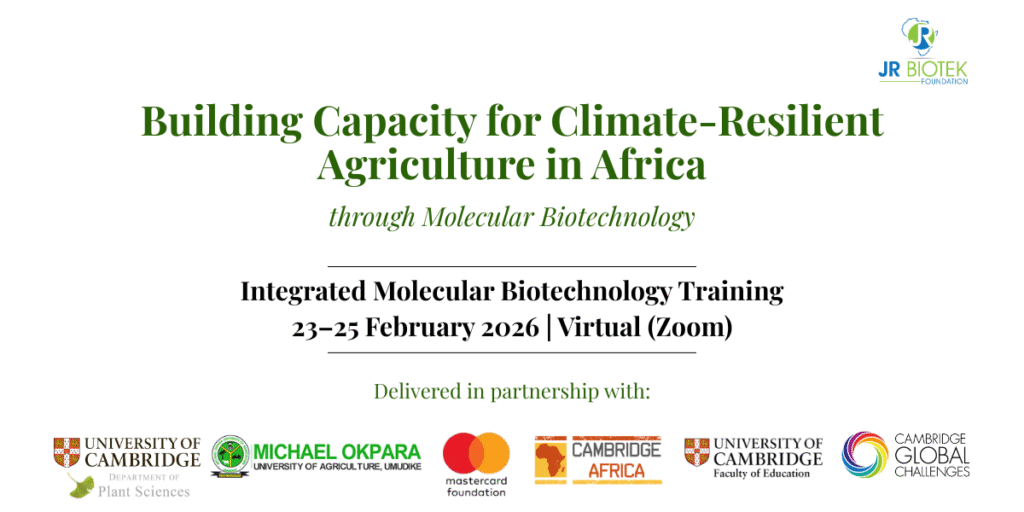
Theme: Advancing Climate-Resilient Agriculture in Africa through Molecular Biotechnology
23–25 February 2026 | Virtual (Zoom) | 10:00 AM (GMT) Daily
JR Biotek Foundation, co-delivering in collaboration with Michael Okpara University of Agriculture, Umudike (Nigeria) and the Department of Plant Sciences, University of Cambridge, announces a three-day virtual training programme advancing molecular biotechnology capacity for climate-resilient agriculture across Africa.
Delivered as part of the project Building Nigeria’s Capacity for Climate-Resilient Agriculture through Molecular Biotechnology, and supported by the Mastercard Foundation and the University of Cambridge Climate Resilience and Sustainability Funds, the workshop brings together leading scientists and trainers from Africa and Europe to equip early-career agricultural researchers with practical molecular bioscience, bioinformatics, and innovation skills.
Learn more, including the programme timetable, lecturers and acknowledgements below!
Programme Overview
This three-day virtual training programme is designed to strengthen molecular biotechnology capacity among African crop and agricultural scientists. The workshop forms a flagship training component of the project:
“Building Nigeria’s Capacity for Climate-Resilient Agriculture through Molecular Biotechnology.”
The broader initiative includes:
- Hands-on laboratory training programme in collaboration with MOUAU in Nigeria
- Structured farmer–policy engagement activities
- Translational science for real-world agricultural impact
The project is led by Dr Carol Ibe (University of Cambridge / JR Biotek Foundation) in collaboration with Professor Olayinka Nwachukwu (Michael Okpara University of Agriculture, Umudike, MOUAU, Nigeria) and supported by:
-
JR Biotek Foundation
-
Department of Plant Sciences, University of Cambridge (Carr Lab)
-
Cambridge Global Challenges Interdisciplinary Research Centre
-
Mastercard Foundation & University of Cambridge Climate Resilience & Sustainability Research Fund
-
Cambridge-Africa Programme
Why this Virtual Programme Matters
This workshop follows an overwhelming response of over 1,660 applications from across Nigeria for just 20 hands-on laboratory places, highlighting the urgent demand for modern molecular bioscience skills.
To broaden access and respond to continental need, this virtual training has been opened to agricultural scientists across Africa, with participants already registered from more than 25 countries.
By combining Nigeria-based implementation with Africa-wide participation, the programme:
-
Strengthens continental knowledge exchange
-
Expands access to world-class molecular bioscience training
-
Positions Nigeria as a regional hub for climate-resilient agricultural biotechnology
-
Builds pathways from research to innovation and enterprise
What You Will Gain
Participants will gain:
- Practical understanding of molecular biology for crop improvement
- Exposure to advanced plant molecular techniques
- Insights into molecular diagnostics and crop health
- Introduction to bioinformatics for plant scientists
- Hands-on data analysis and R-based statistical applications
- Understanding of sequencing technologies (MinION)
- Pathways to innovation and entrepreneurship through AGRIIP
Who Should Attend
This workshop is ideal for:
-
Early-career agricultural scientists
-
Graduate and doctoral researchers in plant sciences
-
Molecular biology and biotechnology researchers
-
Bioinformatics and data analysis practitioners
-
Academic staff seeking to integrate molecular tools into research
-
Innovation leaders interested in translational agricultural science
Important Preparation (Day 3 Practical Sessions)
Participants are strongly encouraged to join using a laptop. Software installation guidance will be shared with registered participants prior to the workshop to enable full participation in practical sessions.
Training Timetable (GMT / UK Time)
Day 1 – Molecular Foundations & Crop Health Under Climate Stress
Monday, 23 February 2026 | 10:00–13:40 GMT
-
Opening & Programme Framing
Professor Olayinka Nwachukwu (MOUAU, Nigeria) & Dr Carol Ibe (University of Cambridge / JR Biotek Foundation) -
Fundamentals of Molecular Biology for Crop Scientists
Professor Ifeoma Irene Ijeh (MOUAU, Nigeria) -
Advanced Molecular Techniques in Plant Research
Junior Lusu Kika (University of Cambridge) -
Molecular Virology & Diagnostics for Crop Health
Dr Francis Wamonje (NIAB, United Kingdom) -
General Discussion & Consolidated Live Questions
-
Closing Reflections
Day 2 – Applied Biotechnology, Breeding & Field-Ready Genomics
Tuesday, 24 February 2026 | 10:00–14:05 GMT
-
Engineering Climate-Smart Crops
Dr Pallavi Singh (University of Essex, UK) -
Molecular Breeding for Climate Adaptation
Bernice Ngina Waweru (John Innes Centre, UK) -
Root–Microbiome & Mycorrhizal Research
Dr Ikwuakonam George Okoro (MOUAU) -
Biostimulants & Abiotic Stress Tolerance
Dr O. Lekan Jolayemi (JR Biotek Foundation) -
Portable Sequencing with MinION
Charles Kayuki (Oxford Nanopore Technologies)
Day 3 – Bioinformatics, Statistics & Innovation Pathways
Wednesday, 25 February 2026 | 10:00–15:30 GMT
⚠ Participants must pre-install required software (instructions provided in advance).
-
Introduction to Bioinformatics for Plant Scientists
Mujeeb Adaraloye (University of Cambridge) -
Bioinformatics for Crop Genomics – Guided Practical
Love Odunlami (Earlham Institute, UK) -
Data Analysis & Statistics with R
Dr Chisimkwuo John (MOUAU, Nigeria) -
AGRIIP Innovation & Entrepreneurship Fellowship
Mainda Kiwelu & Olanrewaju Babalola (JR Biotek Foundation) -
Final Reflections & Next Steps
Register to Join the Workshop
Registration remains open to receive joining information and Zoom access details at least two days before the programme begins.
Acknowledgements
This training programme forms part of the project Building Nigeria’s Capacity for Climate-Resilient Agriculture through Molecular Biotechnology and has been made possible through the collaboration, leadership, and support of numerous individuals and institutions.
Project Leadership & Organising Team
We gratefully acknowledge the leadership and coordination of:
-
Professor Olayinka Nwachukwu – Africa Principal Investigator (PI) & Project Co-Lead, Michael Okpara University of Agriculture, Umudike (MOUAU), Nigeria
-
Dr Carol Ibe – Cambridge PI & Project Co-Lead, University of Cambridge / JR Biotek Foundation
-
Dr Ikwuakonam George Okoro – MOUAU
-
Mujeeb Adaraloye – University of Cambridge
-
Christianah Oseni – Programme Coordination (Harper Adams University, UK)
We also acknowledge the strategic guidance and institutional support of:
-
Professor John Carr and the Carr Lab, Department of Plant Sciences, University of Cambridge
-
Department of Plant Sciences Teaching Laboratory Team, led by Barbara Landamore
Institutional & Funding Support
This programme is co-delivered by JR Biotek Foundation in collaboration with Michael Okpara University of Agriculture, Umudike (MOUAU), Nigeria, and the Department of Plant Sciences, University of Cambridge.
We gratefully acknowledge the support of:
-
Mastercard Foundation & University of Cambridge Climate Resilience and Sustainability Funds
-
Cambridge-Africa Programme
-
Cambridge Global Challenges Interdisciplinary Research Centre
-
Faculty of Education, University of Cambridge
Lecturers & Contributing Experts
We extend our sincere appreciation to all lecturers and expert contributors who generously shared their time and expertise:
-
Professor Ifeoma Irene Ijeh (MOUAU, Nigeria)
-
Junior Lusu Kika (University of Cambridge)
-
Dr Francis Wamonje (NIAB, United Kingdom)
-
Dr Pallavi Singh (University of Essex, United Kingdom)
-
Bernice Ngina Waweru (John Innes Centre, United Kingdom)
-
Dr O. Lekan Jolayemi (JR Biotek Foundation)
-
Charles Kayuki (Oxford Nanopore Technologies)
-
Love Odunlami (Earlham Institute, United Kingdom)
-
Dr Chisimkwuo John (MOUAU, Nigeria)
-
Mainda Kiwelu (JR Biotek Foundation / AGRIIP)
-
Olanrewaju Babalola (JR Biotek Foundation / AGRIIP)
Their collective expertise reflects a strong network of African and international collaboration advancing molecular biotechnology for climate-resilient agriculture.